
You know the photos. Your hair looks effortless in an amazing style you’ve never tried before, but somehow it just seems to work perfectly on you. If it seems too good to be true, you’re on the right track.
AI can show you a new haircut or colour in seconds; you might think it’s much better than finding an existing reference photo. But how closely does that picture reflect what your hair can actually achieve? As a stylist, I’ll explain where AI references can mislead you, what affects your hair that AI misses, and how a consultation helps turn inspiration into a realistic plan.
What Actually Happens When AI Changes Your Hair
When you upload your photo to an AI tool like ChatGPT, the model constructs an image based on the information it has and the prompt you’ve put in. It’s more complicated than simply taking your photo and applying new hair to the image.
OpenAI describes image-model training in terms of learning relationships between pixels and associated captions: what different colours, textures, shapes and styles tend to look like. Your photo is the visual starting point. Your request, like “give me a chin-length bob” or “make my hair platinum white”, is the desired change.
Depending on the tool, the software may identify the hair area and select a region to change. One established editing technique, called inpainting, uses a mask to mark where new content should be generated while retaining surrounding content. The software creates detail to depict strands, highlights, shadows, edges, and whatever is needed to make the new hair convincingly fit the picture.
This is where the disconnect between your real hair and the image starts, because the AI can generate any changes you ask for without establishing whether your hair could ever really look like that in reality. After all, the job you’ve given it is to just create an image, right?
How Do AI Hair Apps Work?
So what about hair and beauty apps that use AI like YouCam, FaceApp, and Facetune? Are these tools trained using more specialist considerations to produce more realistic results? That’s what you’d expect from a dedicated AI.
The truth is that most of these tools work the same way as tools like ChatGPT behind the scenes. Their value lies mainly in an easy-to-use user experience for a very specific purpose. A dedicated app can package the process around hair:
- Preset cuts and shades.
- Controls for selecting and comparing looks.
- Hair-specific detection or analysis.
- A more controlled editing workflow.
ChatGPT offers a conversational approach: users can explain their preferences, supply context and request revisions. Its image-generation tools accept text and image inputs. So these beauty apps might be ‘better’ in that they offer an easier experience and presets that give you ideas you wouldn’t have thought of yourself, but ultimately the output is the same.
In fact, many beauty apps rely on pre-made filters and settings that can be mapped onto the images you supply, meaning the results are even less realistic than when an LLM tool does it for you.
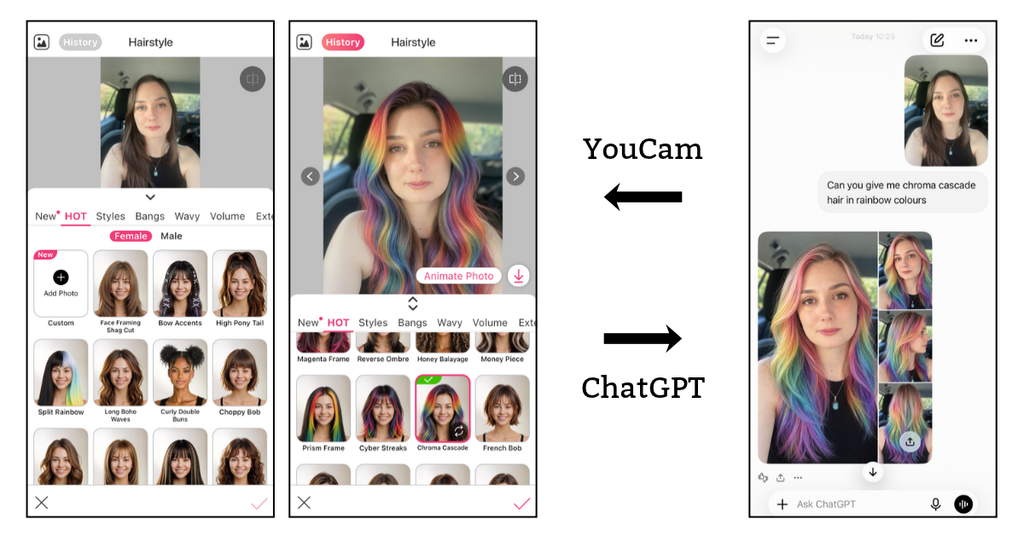
Asking for the same hairstyle in YouCam and ChatGPT
What AI Hair References Miss Out
When you ask AI to show what a certain haircut, colour, or style would look like on you, it delivers a result. But AI doesn’t stick to the guardrails of reality when it’s working to the prompt you’ve provided. In reality, many factors determine how a haircut or style will look on you and whether it can be recreated. Your hair doesn’t just sit there like it does in a photo; it moves, has weight, density, texture, and growth patterns that affect the way it falls. Your day-to-day life also affects how your hair looks at any moment.
These are factors that trained stylists have to acknowledge if they want to give you real results that actually work and look good.
The UK National Occupational Standards for restyling include consultation, lifestyle, head and face structure, hair analysis and discussion of achievable looks. Relevant hair characteristics include density, texture, elasticity, porosity and growth patterns.
Here’s a breakdown of these characteristics and how AI assesses them vs a human stylist:
| Factor | How it affects your options | What AI cannot reliably establish from a photo | What your stylist checks |
| Hair density | How much hair you have affects fullness, coverage and how much can be used for a fringe or layers. | Lighting, parting and styling can make hair appear fuller or sparser. One angle cannot show its distribution across your head. | Sections the hair and assesses density in different areas to judge whether the desired shape has enough coverage. |
| Strand thickness | Fine, medium and coarse strands behave differently, affecting how a cut holds its shape and responds to styling. | Overall fullness does not reliably reveal the thickness of individual strands. | Examines and feels the strands, distinguishing their thickness from the amount of hair you have. |
| Natural texture | Straight, wavy, curly and coily hair can produce different results from the same cut. Your texture affects movement, volume and the length visible when dry. | A photo may show blow-dried, straightened or curled hair rather than its natural behaviour. | Discusses your natural texture and assesses how it falls, including differences between sections and changes when dry. |
| Growth patterns | Cowlicks, crowns and hairline growth affect how fringes, partings and shorter sections sit. | A styled photograph can conceal the direction hair naturally grows, particularly at the roots. | Examines the roots, hairline and crown, then considers how the proposed cut would work with those patterns. |
| Existing length and layers | Your current cut determines which shapes are achievable immediately and which need growing time or a shorter overall length. | One photograph may hide shorter layers, uneven sections or the true length at the back. | Checks lengths throughout the hair and explains what can be reshaped now and what needs time to grow. |
| Condition and treatment history | Breakage and previous colouring or chemical treatments can affect length retention and suitability for further processing. | Shine does not prove good condition. A photo cannot reveal a complete treatment history or test the hair’s strength. | Asks about previous treatments, examines the hair and carries out relevant tests before recommending chemical services. |
| Styling routine | A look needs to fit the time, tools, skills and budget you have for maintaining it. | A finished image cannot reveal how much effort you are willing or able to spend recreating it. | Asks how you manage your hair, explains the work involved and suggests adaptations to suit your routine. |
It’s also worth asking yourself: are you looking for a haircut, a finished style, or both? Because AI references almost always add volume, texture, and shape to your hair that you may not want to style in every day.
How ChatGPT Tricks You
AI tools are widely known for being sycophantic, meaning they prioritise user approval, flattery, or agreement over objective truth and factual accuracy.
In 2023, Anthropic conducted research into sycophantic behaviour and found it across five AI assistants and four types of text-generation tasks. Its analysis suggested that human preferences can partly encourage responses that match users’ views rather than prioritise truthfulness. More recently in 2025, OpenAI rolled back a GPT-4o update after it produced excessively agreeable responses. OpenAI said it had placed too much emphasis on short-term feedback.
Despite constant reiterations, AI tools still favour sycophantic responses. This makes them unreliable in many ways, including their recommendations about your hair. They are more likely to reinforce your wishes, suggestions, ideas, and thoughts. Encouraging answers can seem like informed assessments even though important factors have been overlooked. AI might give you advice that is more reassuring than realistic without you realising because you don’t know what’s being missed.
There is also evidence that AI-generated images favour idealised and conventionally attractive features without even being asked to. An October 2026 research preprint, Generative AI Produces and Transmits Beauty Bias, audited 27 image generators using prompts that never mentioned attractiveness or beauty. Human participants assessed a subset covering 23 generators and rated their generated faces as significantly more attractive than photographed faces.
Look closely at the hair’s fullness, texture and finish, alongside your facial features and skin. If these have changed too, they may contribute to why you like the result.
An AI Hair Reference Case Study
Recently, a client of mine got in touch with an AI photo reference for a desired hair colouring appointment. She wanted to go from dark brown hair to platinum white. It’s not a request that’s entirely impossible, but the reality is far from the fantasy AI created for her. Here’s why.
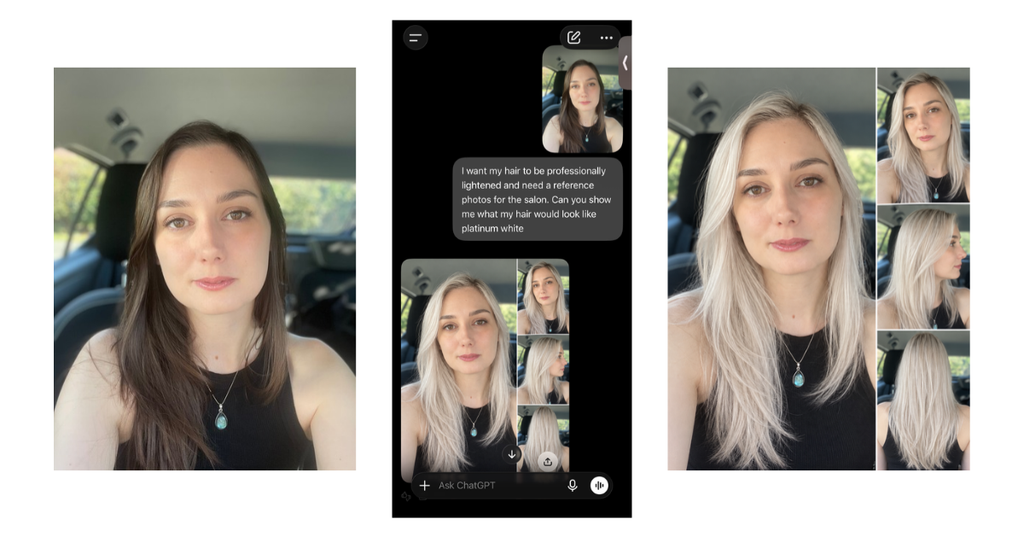
On the left is my client’s original photo. She’s got straight, dark brown hair. Her prompt was simple: “I want my hair to be professionally lightened and need a reference photos for the salon. Can you show me what my hair would look like platinum white”
The resultant photo is on the right. You can already see that ChatGPT has lengthened her hair, given it more volume, more texture, and more shape. It’s given a side and back image too, despite never having these to begin with and it’s assumed what her hair looks like at these angles. You can also see that it’s subtly changed her face, making it shorter, and giving her features more definition.
At first glance, I can see that this is not a realistic option for her. But there’s much more to it.
My client then asked ChatGPT: “Can I get this done in one go? My hair is not naturally this dark and I think there might be a bit of damage.”
And it responded with: “Potentially, yes – but given that your hair is dyed darker than its natural colour and you suspect some damage, I would be cautious about attempting platinum white in one appointment.”
There’s that sycophancy. The problem here is that my client would never be able to reach this platinum shade in one sitting. Trying to achieve that in one appointment can push the hair beyond what it can tolerate, leading to severe breakage, especially if it has already been coloured or damaged. A gradual approach is the only safe way to achieve this.
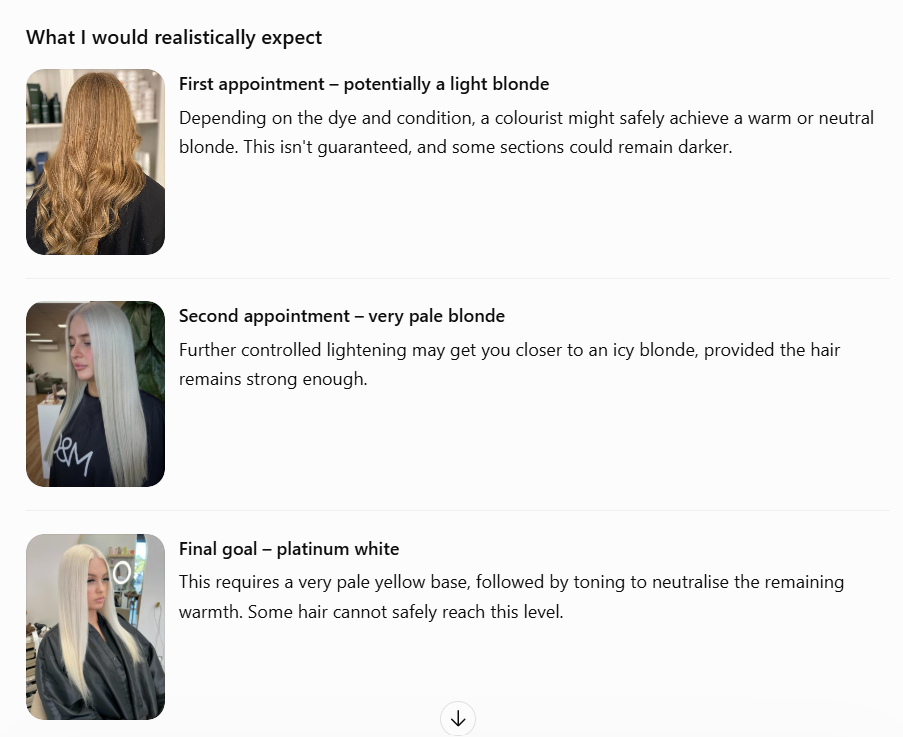
ChatGPT offered my client the following ‘realistic example’ of how this gradual lightening would look in these three stages. Notice the stark difference between the first and second appointment? In my opinion, as a stylist, this is highly unrealistic.
How it Happens in Reality
Before lightening, I’d assess the hair’s current colour, condition and underlying pigment. This client is a 3 or 4 on the chart below. Going from dark brown to platinum involves breaking down pigment through red, orange and yellow stages until the hair reaches a very pale yellow base. A toner can then balance the remaining warmth to create a cooler finish.
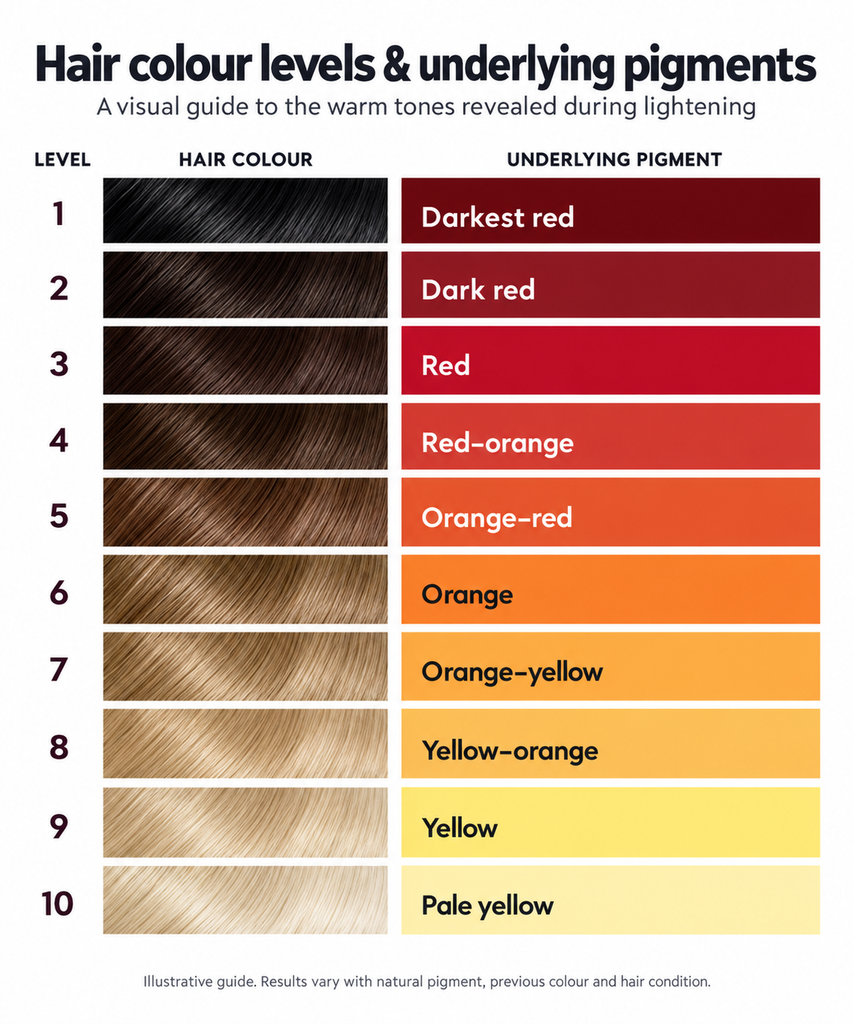
This client said she had previously dyed her hair, which adds another consideration. Artificial colour can leave stubborn pigment or darker bands that lift unevenly. I’d need to understand her colour history and carry out strand tests to assess how the hair responds, both in colour and condition. Different sections may need different treatment.
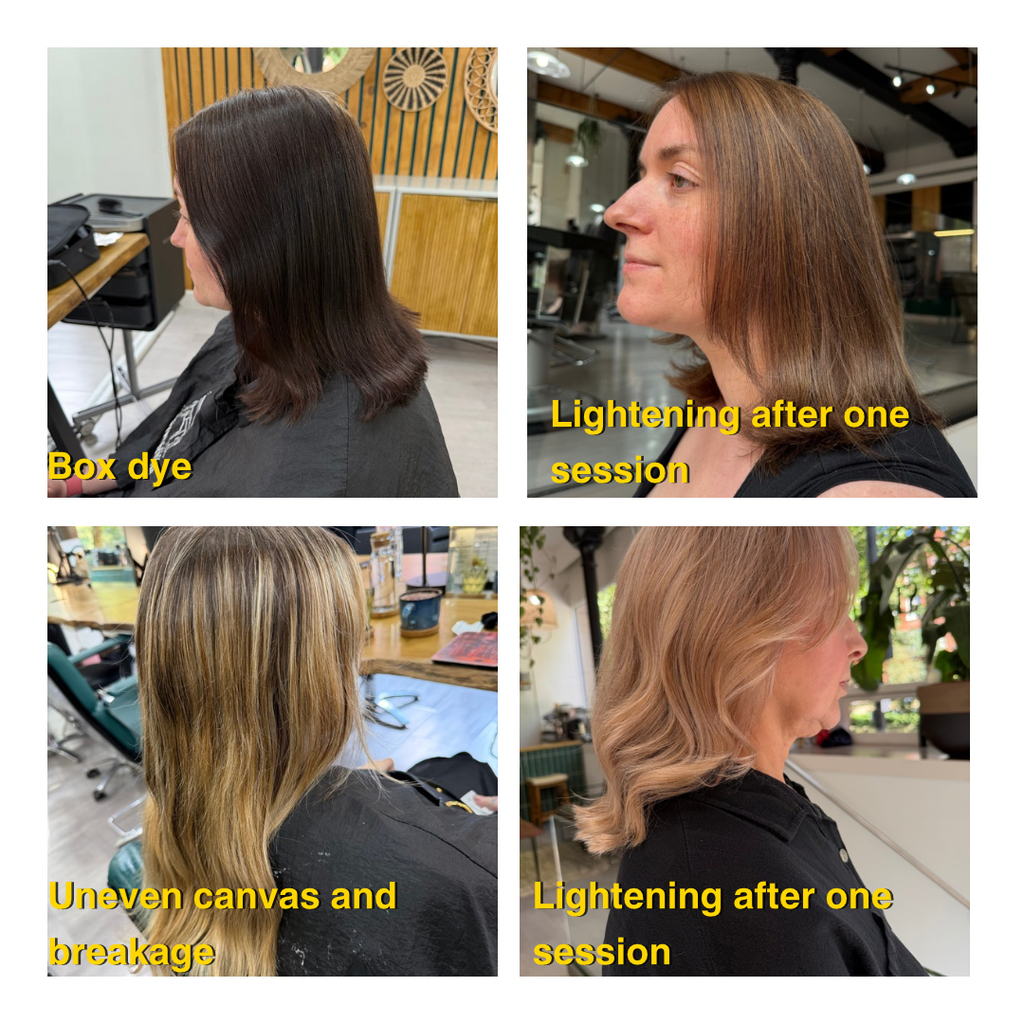
A transformation like this takes hours of careful application, monitoring and toning. To protect hair from serious damage, it needs several visits spread over weeks or months. The timeframe depends on what the hair can tolerate, and reaching platinum may not be even appropriate for already damaged lengths.
Below are real photos of my clients in my salon. The top-left photo shows a client with box-dyed brown hair, and the other photos show her and similar clients’ hair after one lightening session. This goes to show how lengthy and delicate the process is. It’s not about disappointing clients; it’s about my duty of care as a stylist to ensure their hair isn’t damaged and that they leave the salon with a haircut that looks good.
How to Get Better Hair Advice
AI isn’t completely useless, and when you know the right things to ask, you can go into your hair appointment well informed to ask for something that works for you.
Start by understanding the hair you have
Hair type is the most impactful factor in your chosen style, so learn about your hair’s natural characteristics. These are things you simply cannot change about your hair, so being able to work with them means you can find a style that naturally and effortlessly suits you.
Because assessing hair type is much more about how it looks and feels than about judging a photo, a stylist will be the best person to help identify these characteristics. Once you know, it’s really useful information for the future:
| Characteristic | What to know about your hair | What to explore |
| Natural texture | Straight, wavy, curly, coily or a mixture; how it dries without styling. | How different cuts might work with that texture and which looks depend on styling. |
| Strand thickness | Whether individual hairs seem fine, medium or coarse, or whether you are unsure. | How strand thickness differs from density and why that distinction matters. |
| Density | How full or sparse the hair appears, including differences around the hairline. | Why a reference with much fuller hair might need adapting. |
| Growth patterns | Cowlicks, a strong parting or sections that resist lying flat. | What questions these raise about fringes, partings and shorter cuts. |
| Current length and shape | Where the hair falls, existing layers and shorter sections. | Which ideas involve cutting, growing or adapting the existing shape. |
Learn about your face and features
There are six common face shapes that can visually affect a haircut’s proportions, hairline, shape, weight, and other elements. The visual harmony of a hairstyle can vary depending on your face shape. Knowing yours will help when researching cuts that suit you.
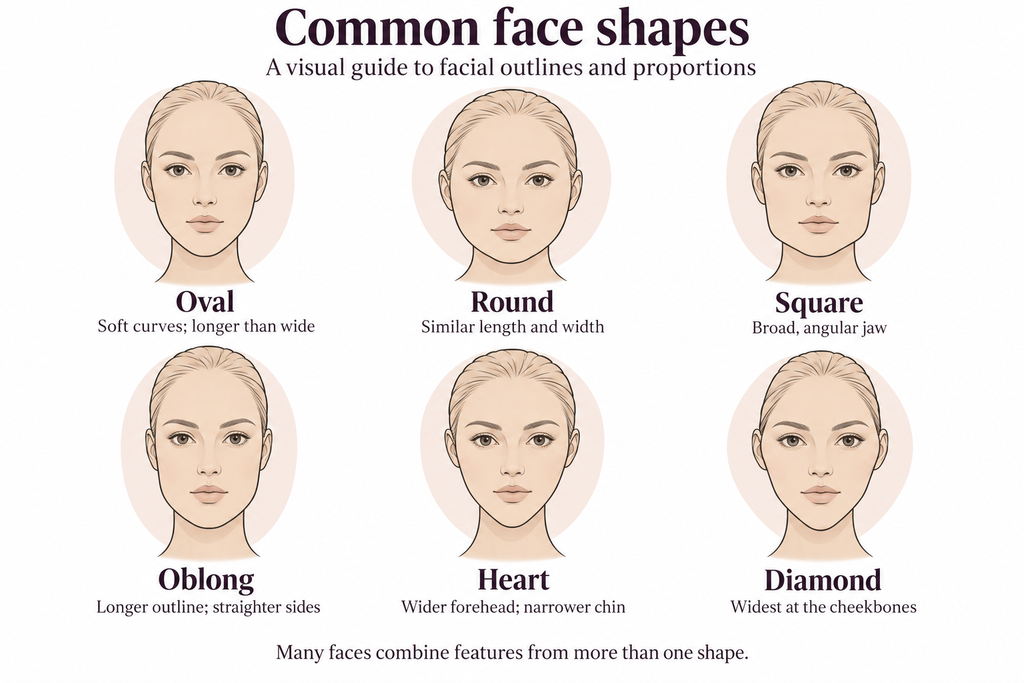
If you plan to ask AI to determine your face shape, upload several different front-facing photos taken in natural lighting that does not cast too many shadows on your face. Ensure your hair is away from your face and you’ve removed glasses or other accessories.
Keep track of your hair’s condition and treatment history
All of the following impact the options available for your new look:
- Natural colour and current colour
- Previous colouring or bleaching, including professional colouring and box dyes
- Perms, chemical straightening or hair relaxing/smoothing treatments
- Breakage, fragile sections, dryness or other concerns
- Medical conditions and medications
I need these details to determine how I can work with your hair and prevent any damage or unexpected results. Putting these into AI can also help you learn about their effects. You could use this prompt:
My hair is currently [description], and its colour and treatment history is [details]. I’m interested in [goal]. Explain which parts of my history could affect the options and what I should ask my stylist.
Remember, AI can help explain impacts. But it cannot confirm the hair’s condition or suitability for a chemical service.
Think about realistic daily maintenance
It’s easy to get excited about a potential new look and tell yourself that you’ll keep up with styling and maintenance, and if you can, then good for you! But it’s also important to think about what’s realistically manageable for you – on busy days, on trips away, during rain and shine, and so on.
All of these factors make up your daily maintenance routine:
- Washing frequency and time available for styling
- Whether you air-dry, blow-dry or use heated tools
- Products and tools you already use
- How often you want to visit the salon
- Whether you tie your hair back or put your hair behind your ear
My aim as a stylist is to make sure your hair falls well and doesn’t drive you mad, even on the days when you’re too busy to style it.
Why Consultation is The Best Way
A reference picture helps me understand what you like. A hair consultation lets us work out how to make those ideas work for your hair. Together, we can identify what appeals to you about a reference and which elements need adapting. If you’re considering a colour change, we’ll discuss your previous treatments and any assessment or testing needed before proceeding.
We can also separate the haircut from the styling: those soft waves or that smooth, full finish may depend on blow-drying, products or heated tools. I’m more than happy to show you how to achieve a style you like at home and weigh in on which hair products would help (but don’t worry, I never, ever upsell specific products).
The aim is ultimately a look you love and feel comfortable maintaining, something completely achievable outside the fantasy world of AI!
Bring your references (AI-generated or otherwise) to a free, no-obligation consultation of up to 30 minutes. We’ll talk through your ideas and agree on a realistic plan. Or book a cut or colour with me today.